Civil liberties and authoritarian impulses: Does Malaysia’s new Bill on Peaceful Assembly reveals UMNO’s true colors or is it a step forward?

Posted on | november 29, 2011 | No Comments
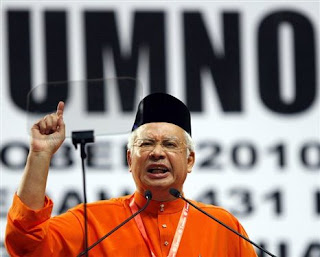
Prime Minister Najib addressing UMNO General Assembly

It was supposed to be a step forward in civil liberties, a law that would give Malaysians the right to peaceful assembly.  But the devil it seems is in the detail. On November 29th it is expected that the Malaysian parliament will pass The Peaceful Assembly Bill and herald it as a new era in civil liberties and political freedom in Malaysia.  However while the bill before parliament will enshrine certain new freedoms in Malaysian law it does so in a regulatory framework that clearly defines the strictures within which those freedoms can be enjoyed. 

Currently Malaysia’s strict security laws require a police permit for a protest of more than five people. The new law by abolishing that requirement is clearly a welcome change. Replacing it initially was a requirement that police be given 30 days notice by organizers of a public assembly. However, in the face of cries of protest from civil society groups and the opposition Pakatan Rakyat, this has now been shortened to 10 days.  Similarly the police will be required to inform organizers within 24 hours of their decision rather than 48 as had been originally stipulated. The right to appeal this decision however has been reduced from its current five days to 48 hours.

The UMNO-led Barisan Nasional government allegedly studied laws on peaceful protest in a number of countries, including Finland and Britain, before largely modeling their Bill on the Australian state of Queensland’s Peaceful Assembly Act of 1992. Where the two differ however is in the slew of restrictions the Malaysian version imposes. Besides the notice period the Malaysian Bill forbids protests within a 50 metre zone of “prohibited areas” (which include bridges, gas stations, hospitals, railways, schools and places of worship); restricts anyone under the age of 15 from participation in any protests; gives police the right to impose conditions on the holding of assemblies and gives the Home Minister the right to decide on appeal. Furthermore illegal assemblies will be fined $3000 (RM10,000), while anyone arrested by police can be fined up to $6000.

However the most restrictive clause in the Bill is the prohibition on the right to march. The Bill explicitly prohibits street protests defined as “ “open air assembly which begins with a meeting at a specified place and consists of walking in a mass march or rally for the purpose of objecting to or advancing a particular cause or causes”. Such a restriction on peaceful protest is both largely contrary to international norms on freedom of assembly and would largely restrict protests to stadia or public halls.  Hailed as ‘revolutionary’ by Prime Minister Najib when he tabled the bill in parliament on November 22nd it has been dismissed by the Malaysian Bar Council president Lim Chee Wee as more restrictive that the present law.
The Bill represents the latest attempt by Prime Minister Najib to reposition the ruling United Malays National Organization before elections widely anticipated within the next 6-12 months.  Thrown off-guard by the 50,000 strong Bersih 2.0 (‘Clean’ )demonstration in July this year, and plagued by continuing corruption allegations, Najib has tried to seize control of the political agenda by making a series of public pronouncements in which he appeared to champion the political liberalization.  Critics were not won over.  The latest Bill seems to suggest that their skepticism was well-founded. For the government the management of the issue has been something of a public relations disaster, not least because just two days after the Bill was tabled, the Burmese government passed its own law on public protest permitting the very marches the Malaysian Bill will outlaw. Now who wants to look more repressive than Burma? 

AUTHOR: Dr. Jason Abbott
URL: http://profjabbott.blogspot.com
E-MAIL: jason.abbott [at] louisville.edu

Comments

Leave a Reply


  • agriculture (29)
    book (3)
    briefing (16)
    business & trade (21)
    child (92)
    consumption (3)
    corruption (20)
    crime (152)
    culture (30)
    defence (15)
    deforestation (6)
    democratization (54)
    demography (6)
    Discovery (5)
    drugs (73)
    Dutch foreign policy (3)
    economic (105)
    education (28)
    effectiveness (3)
    election (64)
    embassy news (1)
    emergency (8)
    energy (42)
    environment (144)
    Eurasia (36)
    Europe (36)
    fair trade (5)
    flora & fauna (24)
    foreign aid (28)
    foreign embassy in the Netherlands (2)
    foreign policy (56)
    gender (17)
    global (270)
    globalization (5)
    health (95)
    history (19)
    homosexuality (4)
    human rights (309)
    hunger & food (20)
    immigration (3)
    infrastructure (28)
    intelligence (7)
    interview (26)
    Latin America (214)
    list (5)
    media (64)
    Middle East (358)
    Millennium Development Goals (21)
    minorities (41)
    movement (38)
    multilateral organizations (40)
    narration (5)
    natural disasters (9)
    Netherlands (31)
    NGO (20)
    NL-Aid (8)
    Northern Africa (187)
    Northern America (130)
    nuclear (4)
    opinion (37)
    Pacific (2)
    peacekeeping (1)
    politics (129)
    poverty (27)
    racism (2)
    raw material (30)
    reconstruction (1)
    refugees (20)
    religion (23)
    remembrance (3)
    research (11)
    revolt (186)
    Royal Dutch Embassy (1)
    sanitation (16)
    slums (2)
    South Asia (451)
    South-east Asia (112)
    study (19)
    Sub-Saharan Africa (446)
    technology (14)
    terrorism (90)
    tourism (6)
    trade (11)
    transport (6)
    Updaid (1)
    war & conflicts (145)
    war crimes (36)
    water (40)
    whistleblower (8)
    women (54)

    WP Cumulus Flash tag cloud by Roy Tanck requires Flash Player 9 or better.

Page 1 of 11